The IRS has a Whistleblower Office, which manages tips for tax evasion, fraud, or underpayment received from whistleblowers. They have released a digital form for whistleblowers so they can report tax cheat and get a reward.
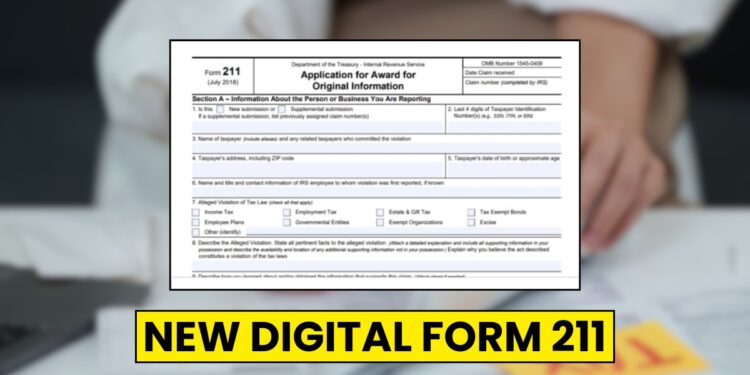
On December 19, 2025, the IRS’s Whistleblower Office announced that we are making it easy for whistleblowers to report tax cheats with the launch of Form 211, ‘Application for Award for Original Information.’
The main reason behind digitizing the process of reporting tax cheats is that the whistleblower can quickly and securely provide the information to the IRS’ Whistleblower Office, and it also reduces transcription errors and costs.
What is it?
The Form 211 is introduced to help the individuals reporting the suspected tax fraud, evasion, or tax law violation. If you know of any tax cheat, you may get a cash award by reporting it to the IRS Whistleblower Office.
The good thing about it is that any whistleblower’s identity is fully protected, and the Department of Labor, United States, protects whistleblowers from retaliation by employers.
What’s required to report a tax cheat?
In order to report a tax cheat, it is mandatory that you have the following information of the person or entity you’re reporting.
- Name, address, and taxpayer identification number, if you know.
- Explanation for the allegation of non-compliance; make sure you explain it clearly.
- Any document to support the allegation that you have made.
- Information about the incident and how and when you suspect the tax cheat.
- All about your present or former relationship with the person or entity against which you have reported.
- Your contact information, such as mobile number, email address, and the address you are residing in.
If you are an employee of the Department of Treasury, you can file this form in order to get rewarded.
Even a federal government employee can’t file and get a reward if he or she becomes aware of the tax cheat through his or her official duty.
What are rewards?
The award you can get as a whistleblower by filing the form 211 usually ranges from 15 to 30 percent of the amount collected because of the provided information.
The award percentage decreases when the claim is made using the information available in the public domain.
The awards are processed as mandatory or discretionary, according to IRC Sections 7623 (b) and (a), respectively. The differences are tabulated below.
| Feature | Mandatory Award (7623(b)) | Discretionary Award (7623(a)) |
| Threshold | Over $2 million (tax, penalties, & interest) | $2 million or less |
| Target Requirement | If an individual, income must be >$200k | No income requirement |
| Award Percentage | 15% to 30% of collected proceeds | Up to 15% (often 1% to 10%) |
| IRS Obligation | Required to pay if criteria are met | Optional; paid at IRS discretion |
| Appeal Rights | Can appeal to U.S. Tax Court | Generally no right to appeal |
| Process Transparency | Whistleblower gets detailed reports on award math | Limited feedback; standard decision letter |
| “Less Substantial” Case | Award capped at 10% (If it is based on public information) | No specific statutory cap other than 15% |
How to claim?
For the instructions for filling out Form 211, please go through the step-by-step instructions available below.
- Navigate the Internal Revenue Service website.
- Type ‘Whistleblower Claim’ in the search bar.
- Find and click on ‘Submit a whistleblower claim for award’ and go to the next page.
- Now, tap on the ‘Submit Form 211’ and go to another page.
- Read all the instructions and click on the Next button to complete Sections A, B, and C.
- Attach all the documents you have to prove your allegation, and submit it.
After filing the Form 211, you will get a letter via mail with confirmation that they have received it; it will also have a claim number, and you will be able to use it if you need to contact the IRS’ Whistleblower Office.
Important Notes
If you get more information about any tax cheat, and you already have submitted a claim, you can provide additional information using the claim number that you have received via mail.
In case of any mistake, error, or change in contact information as a whistleblower, you have to send the changes as soon as possible to:
- Internal Revenue Service
- Whistleblower Office – ICE
- 1973 N Rulon White Blvd.
- M/S 4110
- Ogden, UT 84404
Disclaimer: Information about the IRS’s new digital Whistleblower Form 211 is for general awareness only. Official procedures and requirements are determined by the IRS.